



























































Uncategorized
PoE Switch vs Regular Switch: What Is the Difference?
Sep
Choosing the right network switch is an important part of building a reliable business network. Whether you are connecting computers, IP cameras, wireless access points, VoIP phones, or other Ethernet devices, the type of switch you choose can affect installation, power management, scalability, and overall network setup.
Two common options are PoE switches and regular network switches. While both can connect devices over an Ethernet network, they are designed for slightly different requirements.
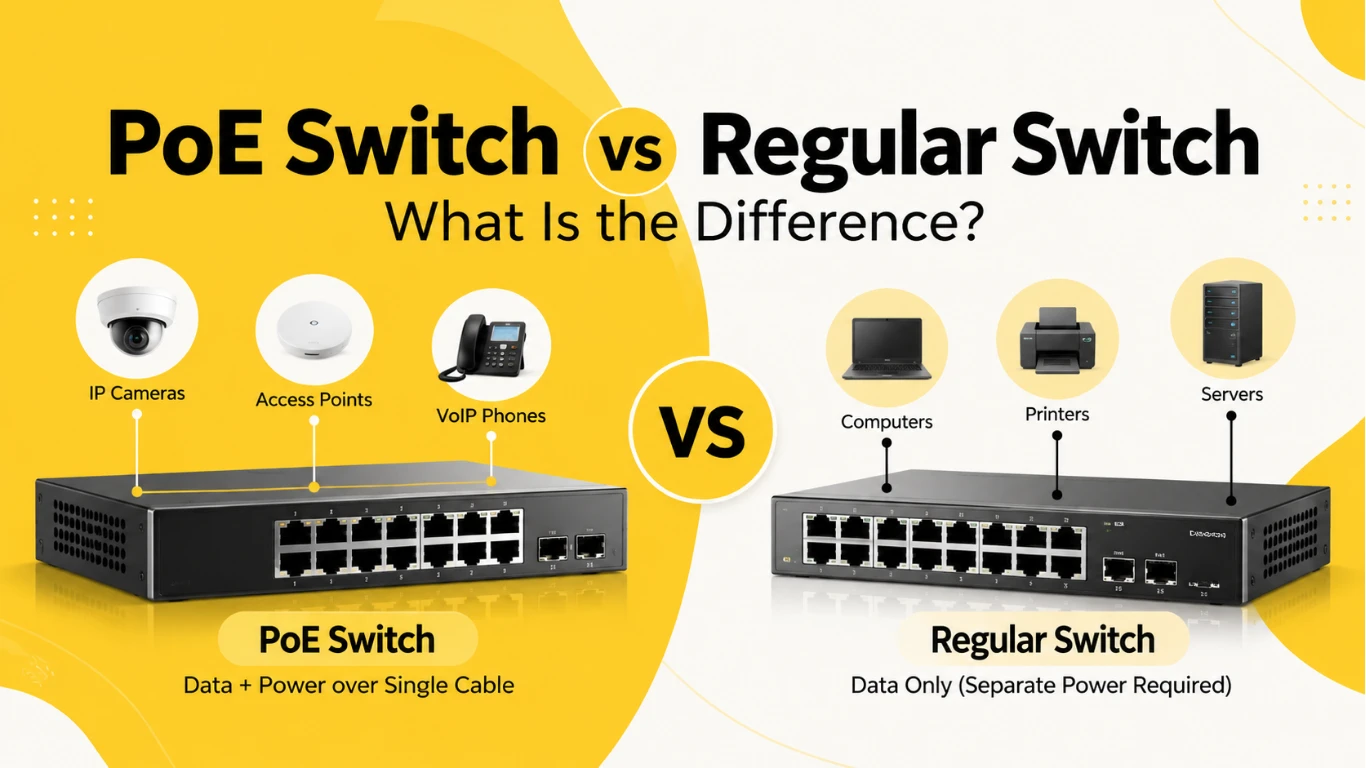
The main difference is simple: a PoE switch can transmit both data and electrical power through the same Ethernet cable, while a regular switch primarily provides network connectivity and connected devices generally need their own separate power source.
If you are comparing a PoE switch vs regular switch for a business, CCTV installation, office network, or Wi-Fi setup in the UAE, understanding this difference can help you select the right solution.
What Is a PoE Switch?
A Power over Ethernet (PoE) switch is a network switch that can deliver data and electrical power through a compatible Ethernet cable. This means devices such as IP cameras, wireless access points, and VoIP phones can receive network connectivity and power through the same cable.
PoE technology is based on IEEE standards such as 802.3af, 802.3at, and 802.3bt. Depending on the standard and equipment, PoE can provide different levels of power to connected devices. For example, IEEE 802.3af provides up to 15.4W from the power source, while 802.3at can provide up to 30W, and 802.3bt supports higher-power applications.
This makes PoE switches particularly useful where devices need to be installed away from convenient electrical outlets.

What Is a Regular Network Switch?
A regular network switch, sometimes called a non-PoE switch, connects multiple devices within a local network and allows them to communicate with each other.
For example, an office may use a regular Gigabit switch to connect desktop computers, printers, servers, and other network-enabled devices. However, the switch itself does not normally provide PoE power to connected devices.
If an IP camera or wireless access point requires power, it will generally need a separate power adapter, power source, or another suitable method of supplying electricity.
Regular switches can therefore be a practical choice for networks where connected devices already have independent power arrangements.
PoE Switch vs Regular Switch: Key Differences
The biggest difference between a PoE switch and a regular switch is power delivery, but there are several other factors worth considering.
Feature |
PoE Switch |
Regular Switch |
| Network connectivity | Yes | Yes |
| Power over Ethernet | Yes | No |
| Data + power through one Ethernet cable | Yes | No |
| Separate power adapter for PoE devices | Usually not required | Generally required |
| Suitable for IP cameras | Yes | Yes, but separate power is needed |
| Suitable for Wi-Fi access points | Yes | Yes, with separate power |
| Suitable for VoIP phones | Yes | Yes, with separate power |
| Installation flexibility | Higher for PoE devices | Depends on nearby power availability |
| Typical use | CCTV, APs, VoIP, IoT | PCs, printers, servers and standard network devices |
Power Delivery
A PoE switch can provide both network connectivity and power through a compatible Ethernet connection. This reduces the need to install a separate power connection for every compatible device.
A regular switch provides network connectivity but does not provide standard PoE power. Devices that require electricity will need another power source.
Cabling and Installation
PoE can simplify installation because a single Ethernet cable can carry both data and power to a compatible device. Cisco notes that combining power and data over one cable can reduce cabling requirements and simplify installation.
This can be especially useful for IP cameras mounted on ceilings, walls, entrances, parking areas, or other locations where installing a separate electrical outlet may be inconvenient.
With a regular switch, the network cable handles data while the device normally needs a separate power connection.
Use Cases
The right choice largely depends on what you are connecting.
PoE switches are commonly used for:
- IP CCTV cameras
- Wireless access points
- VoIP phones
- Certain IoT and network devices
- Other compatible PoE-powered equipment
Regular switches are commonly used for:
- Desktop computers
- Printers
- Servers
- Network storage
- Non-PoE devices
- General office networking
For example, if a company is installing several IP cameras throughout an office or warehouse, a PoE switch can help simplify the network and power setup.
Why Are PoE Switches Useful for CCTV?
CCTV is one of the most common applications where PoE technology can be useful.
An IP camera needs both network connectivity and electrical power. With a compatible PoE switch, both can be delivered through a single Ethernet cable. This can make installation more straightforward and reduce the need to arrange separate power outlets near every camera.
For businesses installing multiple cameras, this can also make cable management easier.
However, the switch still needs to have enough PoE power budget for the connected cameras. It is therefore important to check the power requirements of the cameras and the total PoE budget of the switch before purchasing.
PoE Switch vs Regular Switch: Which One Should You Choose?
The answer depends on your network requirements rather than simply choosing one type for every installation.
A PoE switch may be suitable if your network includes several devices that need power over Ethernet. This is particularly relevant for CCTV systems, wireless access points, and VoIP deployments.
A regular switch can be suitable when your connected devices already have their own power sources and you mainly need additional Ethernet ports for network connectivity.
For example, an office with computers and printers that already have power connections may not need PoE on every port. On the other hand, a business deploying IP cameras across multiple floors may benefit from PoE connectivity.
What Should You Check Before Buying a PoE Switch?
Before purchasing a PoE switch in the UAE, don’t look only at the number of ports. Consider the complete network requirement.
Number of Ports
Choose a switch with enough ports for your current devices while allowing some room for future expansion. PoE switches are available in different port configurations, so the right size depends on your network.
PoE Power Budget
Check how much total power the switch can provide and compare it with the combined requirements of your PoE devices.
For example, a switch may have 16 PoE ports, but that does not necessarily mean every port can simultaneously deliver the maximum supported power. The overall power budget is an important specification.
PoE Standard
Check whether the switch supports the PoE standard required by your devices. IEEE 802.3af, 802.3at and 802.3bt support different power levels.
Network Speed
For business networks, consider whether you need Fast Ethernet, Gigabit Ethernet, or higher-speed uplinks. The right choice depends on the amount of network traffic and connected devices.
Managed vs Unmanaged
You should also consider whether you need a managed or unmanaged switch. Managed switches provide more configuration and monitoring options, while unmanaged switches are generally simpler to deploy.
Explore Networking Switches in UAE
If you are looking for networking switches in Dubai or the UAE, Cost to Cost offers a range of Ethernet switches from brands including Cisco, D-Link, TP-Link, Cudy, Aruba, Edgecore, EnGenius and Ubiquiti. The category includes different port configurations as well as Gigabit and PoE models.
For example, the current range includes products such as the Ubiquiti UniFi USW-16-PoE Gen2, Ubiquiti UniFi Switch Lite 16 PoE, and several Cisco PoE+ switches.
You can compare specifications, port configurations, PoE capabilities, and other features before selecting a switch for your network.
Explore Networking Switches in UAE at Cost to Cost
Final Thoughts
The main difference between a PoE switch and a regular switch comes down to how connected devices receive power. Both can provide network connectivity, but PoE adds the ability to deliver power through Ethernet to compatible devices.
For standard office devices such as computers and printers, a regular network switch may meet the requirement. For installations involving IP cameras, Wi-Fi access points, VoIP phones, and other PoE-compatible devices, a PoE switch can simplify cabling and installation.
Before buying, compare the number of ports, network speed, PoE standard, total power budget, and device requirements. This will help you select a switch that fits your current network while allowing room for future expansion.
If you are comparing PoE switches and regular Ethernet switches in the UAE, you can explore the available range at Cost to Cost and check the specifications of individual models before making your selection.
Frequently Asked Questions
Neither is automatically better. A PoE switch is useful when connected devices need power through Ethernet, while a regular switch can be sufficient when devices have separate power sources.
Yes. Compatible Ethernet devices that do not require PoE can generally be connected to a PoE switch. The specific switch and device specifications should always be checked before installation.
Yes. PoE switches are commonly used with compatible IP cameras because they can provide network connectivity and power through the same Ethernet cable.
A PoE switch does not independently create an internet connection. It connects devices within a network and, depending on the network design, connects them to an upstream router or other network infrastructure.
PoE and PoE+ are different IEEE standards. IEEE 802.3af PoE provides up to 15.4W from the power source, while IEEE 802.3at PoE+ supports up to 30W.
Consider the number of devices, required Ethernet speed, number of ports, PoE power budget, supported PoE standard, uplink requirements, and whether you need managed network features.