

























































Uncategorized
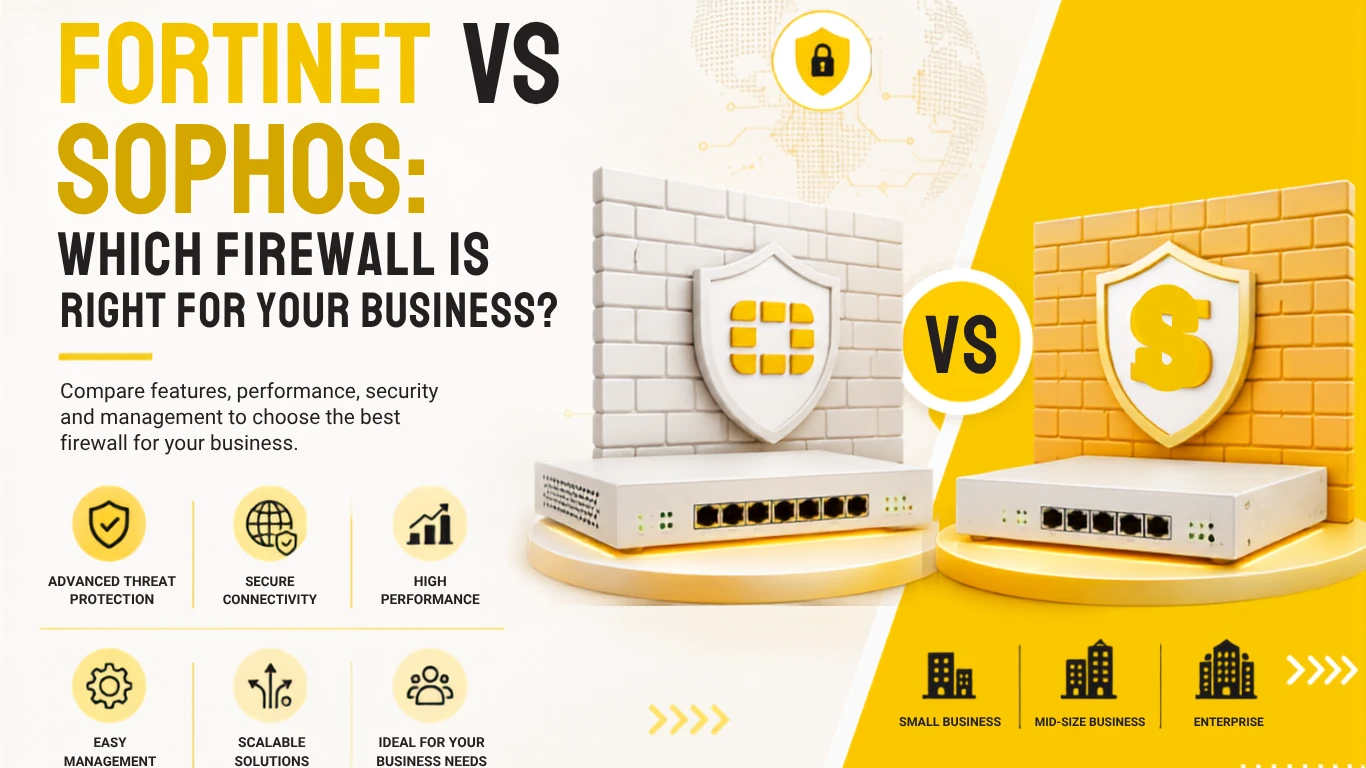
Fortinet vs Sophos: Which Firewall Is Right for Your Business?
Aug
Choosing the right firewall is a real challenge when you’re trying to protect your network, users, and sensitive data. Basic traffic filtering firewalls won’t protect your business from advanced threats. Next-generation firewalls can tackle a wider breadth of issues. These firewalls can address threats that come from remote users, cloud applications, and branch connectivity at an advanced level. These firewalls also accommodate the increasing demands and needs of your business.
A Fortinet vs. Sophos comparison most likely comes into play here.
Each of these firewalls has a large variety of advanced options at their disposal. These include threat prevention, VPN, application control, web filtering, intrusion prevention, and centralized management, just to name a few. It is important to know that there are design philosophies behind each of these features.
Fortinet is known for its strengths in networking with security combined, and Sophos tends to favor providing an easier management pathway of security throughout their integrated security solutions.
Which of these firewalls is better for you?
To answer this, you have to consider your budget, the size of your business, the architecture of your network, the security of your business, the expertise of your IT, and your growth projections.
Fortinet vs Sophos: Quick Comparison
|
Feature |
Fortinet |
Sophos |
|
Firewall Security |
Excellent |
Excellent |
|
Threat Protection |
Advanced |
Advanced |
|
VPN |
Yes |
Yes |
|
Application Control |
Yes |
Yes |
|
Web Protection |
Yes |
Yes |
|
SD-WAN |
Strong |
Strong |
|
Centralized Management |
Yes |
Yes |
|
Scalability |
Excellent |
Excellent |
|
Ease of Management |
Advanced |
User-friendly |
|
Ideal For |
Complex networks |
SMB & mid-market |
This Fortinet vs Sophos comparison shows that both platforms are capable business firewall solutions. The differences become more noticeable when you consider how your organization operates.
What Is Fortinet Firewall?

Fortinet Firewall is part of a next-gen firewall range suited for businesses of all sizes. Fortinet as a company is a big player in both network security and in networking solutions and integration.
A Fortinet firewall has a combination of several different controls and protections. These include VPN and SD-WAN among others.
Fortinet has the advantage of networking integrated security. This is very useful especially for big businesses, with traffic requirements that demand complicated infrastructure and with several business premises.
Fortinet has a lot of different protections and services. This portfolio aids businesses in making additional protection layers to their network.
If performance, protection, and detailed network control are your top priorities in the Fortinet vs Sophos decision, Fortinet is the one to choose.
What Is Sophos Firewall?

Sophos firewall is an easy to manage part of a next-gen security platform being designed and developed to protect business networks.
Sophos’ protection suite has centralized management and provides intrusion prevention, web protection, application control, VPN and traffic inspection, as well as malware protection.
Managing several Sophos security products together is one of the big advantages Sophos offers, giving users integrated protection across the board.
When it comes to integrated simplicity in protection, Sophos has a strong edge in the Fortinet vs Sophos comparison.
Fortinet vs Sophos: Security Capabilities
When you look at business firewalls, security is understandably the most important factor.
Both firewalls will help organizations manage their networks, spot anomalous behavior, enforce application controls, filter web content, and safeguard users from a myriad of cyber threats.
Fortinet Security
Fortinet provides capabilities such as:
- Intrusion prevention
- Application control
- Web filtering
- Malware protection
- VPN
- Network segmentation
- SD-WAN
- Security monitoring
- Threat intelligence
Fortinet’s networking and security solutions fit organizations that need precise control of their networks.
Sophos Security
Sophos Firewall includes:
- Intrusion prevention
- Web protection
- Application control
- Malware scanning
- VPN
- TLS inspection
- Threat protection
- Centralized security management
Sophos also has a large focus on integrated network and endpoint security.
Which Has the Advantage?
From the Fortinet and Sophos comparison there is no clear winner. The balance of network security and management offered is comprehensive from both, and which is the better choice is really down to what the rest of your IT security environment looks like.
Fortinet vs Sophos: Performance and Network Capacity
As businesses turn to faster internet connectivity and more cloud-based apps, the infrastructure demands of modern businesses are straining the capabilities of legacy hardware.
Consider a typical modern business that uses:
- Microsoft 365
- Video conferencing
- VoIP
- Cloud applications
- Large file transfers
- Remote access
- Multiple branch offices
The firewall must examine all of this traffic without degrading the performance of the network.
High-performance networking and security processing is important to many businesses, and this is why both Fortinet and Sophos remain strong contenders in this space.
Fortinet and Sophos both address the needs of security performance in network traffic.
Fortinet and Sophos, like all vendors, must be evaluated on the basis of specific use cases.
When measuring Fortinet and Sophos, businesses should focus majorly on things like actual throughput and not vendor boastings like “maximum throughput.”
Fortinet vs Sophos: Management and Usability
A premium firewall product offering many sophisticated features is practically worthless if your IT staff cannot use the features in a daily practical manner.
Fortinet provides high customizability and deep control. This is a clear differentiator for businesses that are large enough to employ network administrators.
Sophos provides a simplified approach to security. A single pane of control to manage all of the various components of security greatly simplifies the day to day management tasks requirement on IT staff.
Fortinet’s offering is strengthened by its high level of control and customizability, while Sophos makes up for less granular control with a simplified management approach.
This means that Fortinet vs Sophos is less about which one has the superior graphical user interface and more about which one aligns with your organization’s technical competency.
Fortinet vs Sophos: VPN and Remote Work
Remote access is now the norm for most companies.
Employees might need access to internal applications and corporate networks from outside the office.
Both firewall solutions would provide the necessary VPN to access remote networks and offer site-to-site access.
Fortinet is best for companies that have complex requirements for branch access and that are large and highly distributed.
Sophos integrates secure remote access into their security platform as well.
If your company has a small remote workforce, both solutions will work. If your company has many branches, the choice depends on the overall network design.
Thus, the availability of VPN alone won’t affect the choice of Fortinet or Sophos.
Fortinet vs Sophos: SD-WAN and Branch Networking
Companies with several branch offices will need to create more efficient methods to manage the internetworking between branches.
SD-WAN enables a company to control multiple network connections and, based on the company’s needs, manage how different traffic flows across the network.
Fortinet has merged SD-WAN with its secure networking offerings, making this an interesting option for companies that want to establish a large branch network.
Sophos also has SD-WAN and centralized management, so can be used by companies that want to manage their security and connectivity in an integrated framework.
For companies that have a small number of branch offices, either offering may work.
For a large enterprise network with extensive routing needs, and security, Fortinet is likely to have the offerings.
This is one of the situations where the choice of Fortinet over Sophos can be done without viewing the purchase of a firewall as an isolated decision.
Fortinet vs Sophos for Small Businesses
Small businesses have distinct needs from large corporations.
They may have:
- Limited IT staff
- Fewer users
- One or two offices
- Smaller budgets
- Remote employees
- Less complex infrastructure
Small businesses need firewalls that protect consistently despite not having dedicated management.
Sophos’ centralized method of security makes it one of the more appealing options for smaller companies.
Fortinet is also a solid SMB choice, especially if a business expects rapid growth or if higher level control for the business’ network is needed.
Small Business Recommendation
Choose Sophos when:
- Simplicity is important
- Your IT team is small
- You want integrated security
- You already use Sophos products
Consider Fortinet when:
- You expect rapid expansion
- You have multiple locations
- Network performance is a priority
- You need greater network control
For SMBs, the best Fortinet vs Sophos choice is ultimately the one your team can manage effectively while leaving enough room for future growth.
Fortinet vs Sophos for Enterprise Businesses
Enterprise networks have more demanding requirements.
Large organizations may need:
- Multiple security appliances
- High availability
- Advanced network segmentation
- Multiple VPN tunnels
- SD-WAN
- Centralized reporting
- Detailed security policies
- High traffic capacity
- Multiple branch offices
Fortinet offers integration of networking and security and is therefore a strong competitor in this environment.
Sophos, on the other hand, is a strong competitor for enterprise-level use, especially for organizations that rely heavily on endpoints and Sophos’ cybersecurity suite.
When evaluating Fortinet vs Sophos for the Enterprise, organizations should look beyond firewalls and consider the full infrastructure as a whole.
Fortinet vs Sophos: Pricing and Total Cost
The pricing of firewalls is difficult to compare because the total cost of ownership (TCO) goes beyond the initial purchase.
Businesses may also pay for:
- Security subscriptions
- Technical support
- Installation
- Configuration
- Maintenance
- Updates
- Professional services
- Future upgrades
Total cost of ownership (TCO) is more indicative of the long-term value of a solution than the price at the point of purchase.
For instance, there may be a solution with a lower purchase price, but excessive administrative burden and cost are needed to support it after purchase.
Conversely, a solution with a higher purchase price may help you avoid replacing your firewall as your business grows — in other words, you’re avoiding a capital equipment expense down the line.
Taken together, this is why pricing for both Fortinet and Sophos should be considered in the context of your anticipated user growth, expected bandwidth, security requirements, and any other applicable business constraints.
Fortinet vs Sophos: Scalability
When considering scalability, it often takes second place to other features, but when choosing a product that will serve your business for an extended period of time, scalability becomes of primary importance. As your number of employees grows from 30 to 100 or 200, your firewall should be able to grow with your business and support that number of users without a complete overhaul to your network.
Fortinet is particularly attractive for businesses expecting:
- More employees
- More branches
- Higher bandwidth
- More network segments
- Advanced security policies
- Increasing cloud usage
Even as a business expands, Sophos offers features like centralized management for distributed settings.
A key firewall selection principle is to not choose a firewall based solely on present needs.
When doing a Fortinet and Sophos comparison, prioritizing future growth is very important.
Which Firewall Is Better for Your Business?

Rather than asking which brand is universally better, consider what your company actually needs.
|
Your Priority |
Better Fit |
|
Simple administration |
Sophos |
|
Complex networking |
Fortinet |
|
Multiple branches |
Fortinet |
|
Integrated endpoint security |
Sophos |
|
Advanced network control |
Fortinet |
|
Small IT team |
Sophos |
|
Rapid infrastructure growth |
Fortinet |
|
Unified Sophos ecosystem |
Sophos |
|
Enterprise network |
Fortinet |
|
SMB security |
Both |
This gives a clearer picture of the Fortinet vs Sophos decision without treating one platform as the winner for every organization.
How to Choose the Best Business Firewall
Before buying a business firewall, evaluate the following:
1. Number of Users
You need to take into account not only the current number of employees, but also the number that you will have in the foreseeable future.
2. Internet Bandwidth
The firewall should be able to complement the security services you need for your internet connection.
3. Number of Locations
More offices means VPN, secure branch connections, and SD-WAN will make a larger impact on your business needs.
4. Remote Employees
If employees do a lot of work outside of the office, secure remote access should be a major consideration.
5. Cloud Applications
Cloud services can greatly increase traffic and impact the need for security policy spanning.
6. IT Expertise
Depending on the skills of your IT staff, you may need to factor in the cost of expert services.
7. Future Growth
Think about how your needs may change and adjust your hardware and licensing to accommodate that.
These factors are more important than choosing a firewall simply because it is popular.
Why Businesses Need a Next-Generation Firewall

Traditional firewalls primarily focused on controlling network traffic according to predefined rules.
Modern businesses need deeper visibility.
A next-generation firewall can provide additional capabilities such as:
- Application awareness
- Intrusion prevention
- Web filtering
- Malware detection
- User-based policies
- VPN
- Traffic inspection
- Network segmentation
However, a firewall should be considered one layer of a broader cybersecurity strategy.
Businesses should also use endpoint security, secure backup, multi-factor authentication, email protection, access controls, security monitoring, and employee awareness training.
A layered approach provides stronger network security than relying on one technology.
Final Verdict
So, Fortinet vs Sophos, which one should your business choose?
When it comes to performance, advanced networking, great scalability, and a lot of different locations, look no further than Fortinet.
When it comes to more centralized and simplified management along with integrated cybersecurity, Sophos may be a better choice.
When it comes to enterprise environments that are complex, Fortinet may have the more scalable and broader infrastructure capabilities to meet your business’s needs even further down the line.
If your business is an SMB with a smaller IT team, Sophos may be the better choice with more simplified management.
Of course, there is no true winner here.
The right firewall security platform for your business is the one that fits your users, applications, bandwidth, network architecture, security requirements, and capabilities, as well as planned future growth.
When selecting network security equipment for your business in the UAE, it’s important to consider things like local technical support, deployment, warranty, licensing, and long-term maintenance. Otherwise, they are all fairly comparable offerings.
When it comes to Fortinet vs Sophos, price is not the right criteria. The right criteria is your actual network requirements.
CostToCost can help businesses in UAE with the selection of appropriate IT infrastructure including network security solutions and networking equipment.
Frequently Asked Questions
It depends on the business. Fortinet is particularly strong for complex networks, scalability, and advanced networking, while Sophos is attractive for simplified administration and integrated security.
Both can be suitable. Sophos may be preferable when ease of management is important, while Fortinet can be attractive for businesses expecting rapid growth or requiring advanced networking.
Yes. Fortinet provides next-generation firewall capabilities including threat prevention, application control, VPN, intrusion prevention, and network security features.
Yes. Sophos Firewall provides security and networking capabilities suitable for small businesses, mid-sized companies, and larger organizations.
For complex multi-location networks, Fortinet can be particularly suitable because of its networking, SD-WAN, security, and scalability capabilities.
No. A firewall is an important security layer, but businesses should combine it with endpoint protection, secure backups, MFA, email security, monitoring, and employee awareness.