


























































Uncategorized
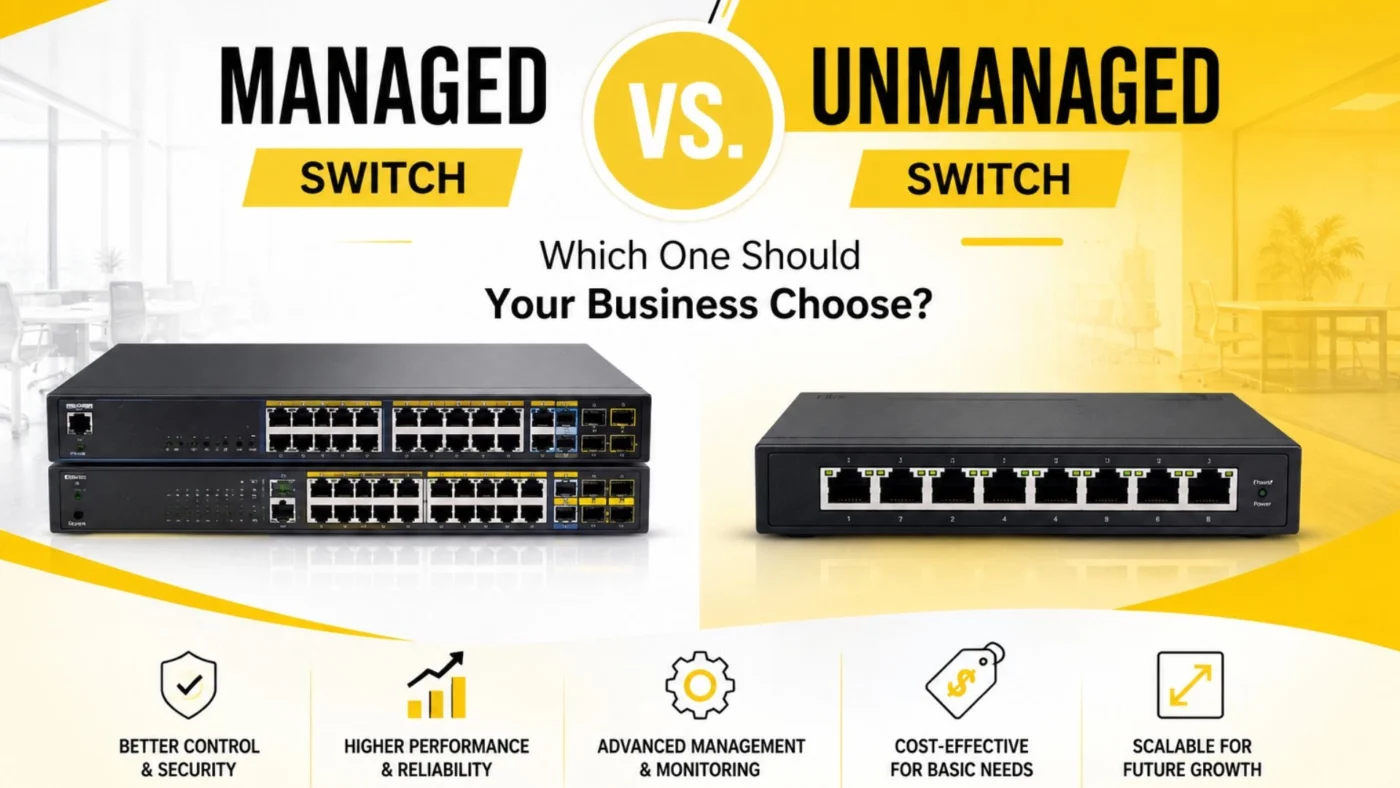
Managed vs. Unmanaged Switch: Which One Should Your Business Choose?
Jul
It’s impossible to overstate the importance of a strong network to a successful business. Employees need reliable access to the tools they need to keep things running, from cloud applications and files to communication tools and more. Constant, reliable connectivity is the main job of a network switch. It connects your computers, servers, printers, cameras, and anything else you need to operate a smooth business.
Unmanaged versus Managed network switches is one of the first questions to come up when businesses begin to expand their IT systems. At a surface level, Managed and Unmanaged switches accomplish the same goals, but their operational philosophies could not be more dissimilar. Unmanaged switches, for example, prioritize Clarity and low cost over control, security, and scalability.
Finding the right solution means looking at your specific business needs. If you’re a small startup, for example, and you only have a couple devices, you may not need the same functionality as a highly secured and fully managed network. Understanding the tradeoffs in switch management and control means building a network that easily adapts to your future requirements and helps you operate your business today.
We will detail and analyze the main discrepancies of managed vs unmanaged switches so that you can find out which switch system gives your business the best value.
Understanding the Role of a Network Switch
In order to have a proper comparison of Managed and Unmanaged switches, an understanding of what a Network Switch does is important. A switch connects all devices on a Local Area Network (LAN) and ensures data is sent to its appropriate destination. Whereas an old hub would connect devices and send data to every device on the hub, a switch sends data to its appropriate destination, thus faster and more efficient communication.
Network switches have many more devices to connect to. Apart from desktop computers, network switches connect wireless access points, business servers, IP Cameras, VoIP Phones and many more business devices. With many businesses adopting more cloud-based technology, the appropriate switch is a more critical aspect of a business’ IT Security infrastructure.
Even with a good internet connection, without a good switch, businesses cannot have IT infrastructure that operates reliably and integrates all business processes. Switches should be a part of a business’s networking strategy.
What Is a Managed Switch?
For a business that needs to manage its network on a greater level, compared to a managed switch, a plug and play type of switch offers very little control. Managed switches allow businesses to control and monitor their network at a greater level.
For example, if a network is fully utilized, a managed switch can prioritize certain applications over others to ensure quality uninterrupted service to select applications.
Another important benefit is network security. For businesses that collect customer data, maintain financial records, and handle sensitive documentation, basic networking options are insufficient. Compared to traditional switches, managed switches have advanced functionalities like VLANs, port security, traffic monitoring, and remote management. These create safer networking environments.
As businesses continue to expand, the advanced features become useful because IT managers are able to control and manage the network without continually replacing older infrastructure.
Key Advantages of a Managed Switch
Most businesses have unique networking needs; however, managed switches have great features making them a great choice for growing businesses.
- Better control over network traffic and connected devices.
- Enhanced security through VLANs and access controls.
- Improved performance with Quality of Service (QoS).
- Remote monitoring and simplified troubleshooting.
- Easier scalability as new users and devices are added.
What Is an Unmanaged Switch?
Unmanaged switches are the simplest form of switches. They require zero configuration, software, or management, thus are immediately operational after being connected. For this reason, switches are a great option for small businesses that have basic networking needs.
Due to their plug-and-play nature, unmanaged switches are seen in home offices, retail shops, small clinics, and small business startups that have a basic network with a few computers and other connected devices. They are a great solution because installation takes little time with no maintenance.
Simplicity comes at a cost: fewer features. Unmanaged switches do not have the ability to prioritize traffic or inspect how devices communicate, meaning they are usually not a good long-term solution for growing businesses.
Managed vs. Unmanaged Switch: At a Glance

Although both types of switches carry a similar fundamental purpose of connecting devices within a network, they do so with entirely different focuses and do so for wholly different market segments. Focus, control, and security are aspects of the solution that managed switches provide, while unmanaged switches are focused on price and ease of use. Below are some features to highlight the focus of the systems.
|
Feature |
Managed Switch |
Unmanaged Switch |
|
Configuration |
Customizable with advanced settings |
Plug-and-play, no setup required |
|
Performance |
Optimizes traffic with QoS |
Standard traffic forwarding |
|
Security |
VLANs, ACLs, and port security |
Basic network connectivity |
|
Monitoring |
Real-time monitoring and diagnostics |
No monitoring features |
|
Scalability |
Ideal for growing businesses |
Best for small networks |
|
Remote Management |
Supported |
Not available |
|
Best For |
Medium & large businesses |
Small offices & startups |
|
Price |
Higher initial cost, better long-term value |
Lower upfront investment |
With the comparison above, it should now be easier to understand the Managed vs. Unmanaged Switch dilemma. In what is discussed above, the managed switch is the correct choice when security, performance, and growth are important. The unmanaged switch would be the correct choice when you simply need inexpensive connectivity for a small office.
Performance Comparison: Does a Managed Switch Make a Difference?
When contrasting Managed versus Unmanaged Switch, a lot of people think a Managed model means faster internet speeds. The assumption is understandable: it’s common for both switches to offer identical options such as Gigabit or multi-Gigabit speeds. However, the main difference is how each model manages network traffic.
Managed switches operate by listening to the flow of data on the network. Unlike Unmanaged switches, which allow all applications to compete for resources, Managed switches can prioritize certain services. As a result, business critical applications such as VoIP calls and file servers are able to perform as expected, regardless of the time of day.
Unmanaged switches, in contrast, allow for the same level of network traffic competition. While this is usually fine for smaller offices with a few connected devices, network congestion is likely when multiple employees are filing, meeting, and accessing applications simultaneously.
For businesses that need to be connected at all times, the investment in a Managed Switch means a better consistent and more reliable network.
Security: Which Switch Offers Better Protection?
Network security is a valid concern now more than ever. Because each connected device can be a cyber threat, exercising caution on the networking equipment is of utmost importance.
Multi-Security Layer Environments on Managed Switches
When dealing with sensitive data, security of the infrastructure is a key consideration. Managed switches come with a plethora of security features. Admins are able to create Virtual Local Area Networks (VLANs), control which ports are accessible, observe traffic, and take action to separate equipment on the network. These capabilities produce increased visibility and reduce the chances of network intrusion.
Unmanaged switches do not support these features. They simply pass data to all the devices connected to the switch ports. While this approach is acceptable for common data, it is not enough for organizations with data of a classified nature.
Security features of a managed switch include:
- VLAN support to separate departments and sensitive systems.
- Port security to prevent unauthorized device connections.
- Network monitoring for faster threat detection.
- Better access control for connected users and devices.
- Easier integration with enterprise security solutions.
Cost Comparison: Is Paying More Worth It?
When buying networking equipment, the cost is the primary concern for most organizations. When looking at the costs of managed vs unmanaged switches, it would appear that unmanaged switches are the clear choice because they have a much lower price.
The decision cannot be based on purchasing without also looking at the cost of ownership. Managed switches deliver value over the long-term by improving the efficiency of the network and downtime. Managed switches simplify network management and are less expensive to operate over time.
An unmanaged switch can be an affordable and viable option for businesses that do not want an especially complex network. An unmanaged switch can be a good option if your office network only needs to connect a few computers and printers. The most important thing is to choose equipment that best suits your current needs and your plans for future growth.
The question should not be which switch is cheaper but rather which is the best solution for the best return on investment over the next five years.
Which Businesses Should Choose a Managed Switch?

Not every company needs complex networking features. Businesses that are growing quickly or that operate a digital heavy business can choose to have the flexibility that comes with a managed switch.
Businesses that routinely utilize the cloud, business servers, surveillance, and multiple wireless access points lack control over network performance. With a managed switch, network performance and security can be enhanced and problems can be fixed proactively instead of reactively.
Managed switches are a great choice for:
- Medium and large businesses with expanding networks.
- Offices using cloud-based business applications.
- Organizations with IP cameras and VoIP phone systems.
- Businesses that require stronger network security.
- Companies planning long-term infrastructure growth.
When Is an Unmanaged Switch the Better Option?
While unmanaged switches are feature poor, they fill an important role in business networking. They are easy, inexpensive, and do not need much technical expertise. Because of this, they can easily be placed in smaller environments.
For small networks, installing an unmanaged switch is as easy as plugging in Ethernet cables. Because there’s no software to configure and no maintenance, unmanaged switches allow staff to concentrate on other tasks instead of network concerns.
An unmanaged switch is commonly the right option when:
- Your office has only a few connected devices.
- Network traffic remains relatively low.
- You don’t require VLANs or traffic prioritization.
- Budget is the primary concern.
- There’s no dedicated IT administrator managing the network.
Real-World Example
Consider two companies, each with around 35 employees.
The first company chooses the unmanaged switch and, for now, has a well performing network. As the company grows and staff begin using Microsoft 365, cloud storage and IP video conferencing and surveillance, network congestion becomes a problem and troubleshooting issues is difficult because the unmanaged switch has no monitoring features.
The second company, with employee growth in mind, chooses a managed switch. The corporate IT staff has the ability to create new VLANs for each department and prioritizes the video conferencing traffic while monitoring network performance and congestion.
This illustrates the problems of select the unmanaged switch with the cheaper upfront costs as opposed to the long term corporate goals and needs for a managed switch. The decision of a Managed vs. Unmanaged Switch should focus on anticipated needs and goals and not just the initial costs.
How to Choose the Right Switch for Your Business

You should now understand Managed vs. Unmanaged Switch. Selecting the appropriate option for your organization doesn’t mean simply selecting the one with the most features. You should take into account the size of your organization, the amount of networking your organization does on a daily basis, the security your organization requires, as well as the future growth of your organization.
Small accountancy practices (say with fewer than 10 employees) have small networking needs compared with larger multi-department firms with networking needs that include IP-based CCTV, Wi-Fi, cloud applications, etc. A switch that meets the requirements of your organization today may need to be replaced sooner than later.
Selecting the right switch also means imagining your organization as it continues to grow. It is almost always more cost-effective to select the right switch (and associated networking equipment) than replacing the equipment as networking needs grow and evolve.
Before Buying, Ask Yourself These Questions
Networking needs should also be evaluated to prevent spending unnecessarily on networking equipment.
- How many devices are currently connected to the network?
- Will you hire more employees over the next few years?
- Do you use cloud-based applications every day?
- Are IP cameras, VoIP phones, or Wi-Fi access points part of your setup?
- Do you have someone who can manage network configurations?
Answering these questions will make it much easier to decide between a Managed vs. Unmanaged Switch.
Common Mistakes Businesses Should Avoid
Most organizations buy networking hardware without thinking about their long-term needs. The cheapest options are appealing, but they easily become limitations as businesses grow.
Another business mistake is not taking network security seriously. Businesses that buy firewalls and antivirus software often forget the security of their network traffic that managed switches offer. Protection of network traffic that basic switches offer is far lower than what is available through managed switches.
Purchasing a switch based only on the number of available ports leads to unbalanced network security. Long-term value of networking hardware is based on both performance and the scalability and security of hardware.
Mistakes that are often made include:
- Choosing a switch based only on price.
- Ignoring future business growth.
- Purchasing more ports than needed while overlooking important features.
- Forgetting to check compatibility with existing networking equipment.
- Buying from unreliable suppliers offering non-genuine products.
Avoiding these mistakes helps ensure your networking investment continues delivering value for years.
Future-Proofing Your Business Network

With technology evolving at a rapid pace, and businesses more reliant on services that cross the internet, and on remote and connected staff, networks must be more secure and easier to manage.
To adapt to most changes quickly and without spending a lot on new core networking hardware, managed switches are best. Expanding office networks, opening additional departments, and adding more wireless access points is easy with a managed switch.
Even though an unmanaged switch might be the best solution for businesses with steady networking needs, for businesses with anticipated growth, an unmanaged switch might be the right decision for short-term needs, but you
Final Verdict: Managed vs. Unmanaged Switch
The business goals ultimately determine whether to use Managed vs Unmanaged Switch and is not just a question of the comparison of the technical aspects.
If your office has a simple network with a low number of connected devices, unmanaged switches deliver good performance and reliability and are easy and inexpensive to install. Unmanaged Switches are ideal solutions for small offices, retail stores, and startups since they do not have sophisticated networking needs.
For business operations that include cloud-based computing, business servers, VoIP, and multiple business departments, managed switches are a better solution. They allow control of network traffic, enhance security, and manage several user-based functions, and provide good investment protection for the future.
It is wise to consider your business’s activities for the next three to five years rather than just for the immediate future. Appropriate networking solutions can achieve operational goals like the optimization of employee productivity and the elimination of expensive recurring upgrades.
Explore Reliable Networking Solutions at CostToCost
CostToCost is your one-stop shop for networking solutions for businesses of all sizes, featuring an extensive inventory of managed and unmanaged switches, PoE switches, Gigabit Ethernet switches, and networking accessories.
To complete your business’s high-performance network solution, browse our selection of routers, wireless access points, network cables, patch panels, and other networking accessories. Our staff is well-equipped to assist you with the most appropriate decision based on your needs with consideration for future expansion.
Frequently Asked Questions
The biggest difference is network control. A managed switch allows administrators to configure, monitor, and optimize the network, while an unmanaged switch works automatically without requiring any configuration.
Not directly. Your internet speed depends on your Internet Service Provider (ISP). However, a managed switch improves the way traffic is distributed across your network, helping cloud applications, VoIP calls, and video meetings perform more efficiently.
Yes. Small businesses with basic networking requirements can benefit from an unmanaged switch because it’s affordable, easy to install, and requires little maintenance.
A managed PoE switch is generally the better option because it supplies both power and data through the same Ethernet cable while offering better traffic management and monitoring capabilities.
Absolutely. Many businesses start with an unmanaged switch and upgrade as their networking requirements increase. However, investing in the right solution from the beginning often reduces future costs and network disruptions.