


















































Uncategorized
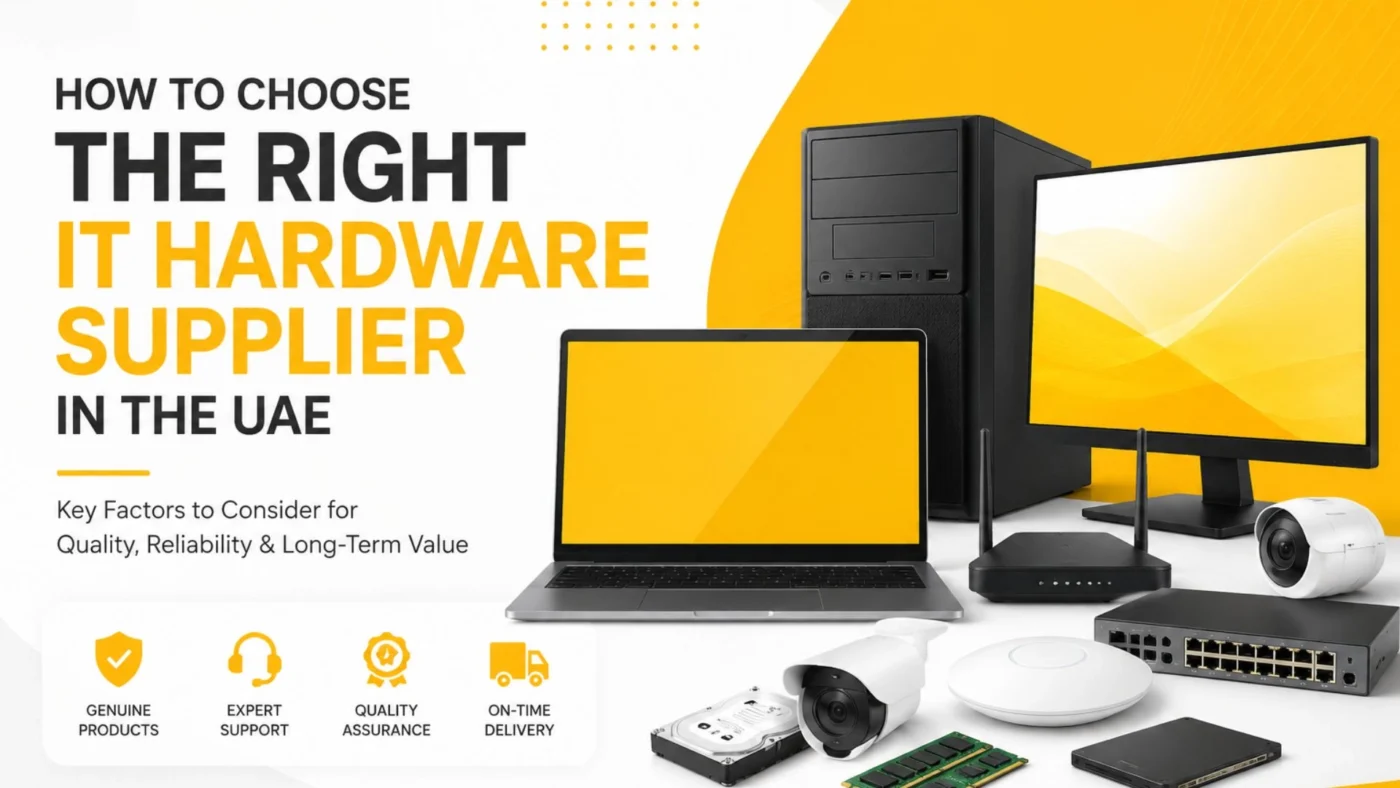
How to Choose the Right IT Hardware Supplier in the UAE: A Complete Buyer’s Guide
Jul
IT hardware supplier is essential for every business in the United Arab Emirates. Whether you have a startup in Dubai, a store in Sharjah, a logistics company in Abu Dhabi, or a large enterprise with multiple branches, reliable IT hardware helps keep your business running smoothly every day. You use laptops and desktops and other things like servers and printers and security systems. All of these things help your business work well and stay connected.
When you want to buy technology it is not about finding the cheapest thing. You need to find a supplier who can help you get real products, tell you what you need and help you when something goes wrong. This way your technology can grow with your business.
There are people who sell technology in the United Arab Emirates. Some just sell you things. Others can really help you with everything. They can give you advice, install things and help you later if you need it.
This guide will tell you what to think about when you want to choose someone to buy technology from, in the United Arab Emirates. It will help you make a choice so your business can do well for a long time.
Why Choosing the Right IT Hardware Supplier Matters
Many businesses do not realize how much their supplier affects how well they do in the long run. The right supplier does a lot more than just bring you computers and things. They become a technology partner who helps your business work well and stay safe. Get ready for growth in the future.
A supplier you can trust makes sure you get products that manufacturers will stand behind, good advice from experts, and technical support you can count on. They do not just tell you to buy the expensive thing. They try to understand what your business wants to do and suggest things that are a good value.
Think about buying networking equipment for your office. It might seem like it saves you money at first. Having a lot of problems with connections, machines not working and having to replace things can cost a lot more than you saved. This is also true for business computers, servers, and things that store data. Buying hardware from a supplier you can trust reduces problems and helps you get more work done.
Choosing the right supplier also makes it easier to grow your business later. As your company gets bigger you will probably need computers, better servers, a better network or more security. Working with the supplier you trust makes sure everything works together and makes it easier to upgrade things later.
Understand Your Business Requirements First

First evaluate your organization’s hardware needs before reaching out to an IT hardware supplier. Most people skip this step because they believe evaluating future needs is not important. This, however, can affect how satisfied you are with your purchases and your budget.
A lot of people purchase hardware based on online reviews or recommendations. A hardware workstation recommended online may be perfect for a design firm, but a hardware workstation would be an unnecessary expense for a firm that uses web-based applications and email.
Here are a few questions that can help you assess your hardware requirements.
- How many employees require computers?
- Will your team work from the office, remotely, or in a hybrid environment?
- Do you need desktop computers or Business Laptops?
- Will your business require centralized Servers for file storage and applications?
- Are you planning to expand within the next few years?
- Do you need secure networking between multiple office locations?
- Will surveillance systems like CCTV Cameras & Security Systems be part of your office setup?
- Do you require Access Control Systems or Time Attendance Machines to manage employee access and attendance?
The better you can answer these questions the better the supplier can tailor their offerings to your business and the better you can avoid purchasing hardware your business will not utilize.
A developing company that will add more workers in the next year should consider buying scalable hardware that won’t need to be replaced soon, as opposed to buying traditional hardware that requires replacement in a short time. Similarly, companies that deal with customer data of a delicate nature should buy devices and networking equipment with a security orientation that can support more sophisticated firewall solutions.
When you understand your business needs, suppliers can offer precise quotes, suggest the right products, and build a supportive infrastructure for your business’s growth.
Look for Genuine Products from Trusted Brands
IT hardware purchases can involve different issues, but product authenticity remains a top concern. Although the availability of various technology products in the UAE market is advantageous, some suppliers do not deal with equipment sourced from authorized distributors.
While you may be tempted to settle for better pricing, unofficial or counterfeit products pose significant threats, including outmoded firmware, performance and compatibility hurdles, and diminished shelf life, all of which are indicative of a shortened product life and lack of warranty.
Suppliers with integrity deal in products that are genuine and manufactured by globally trusted brands. When you deal in legitimate hardware, you experience better performance and have access to the technical support and software updates that come with a warranty from the manufacturer.
Some of the brands that are trusted in the UAE market include:
- HP
- Dell
- Lenovo
- Cisco
- Microsoft
- Fortinet
- Epson
- Canon
- Logitech
- Hikvision
- Dahua
Before making a purchase, ask your supplier:
- Did an authorized distributor source the product?
- Will the product have the official manufacturer warranty?
- Is the serial number legitimate?
- Will the product come with original documentation and accessories?
Not only does choosing legitimate hardware protect the investment, but it also lessens the likelihood of unexpected product failures.
Check the Supplier's Product Range
The more complete the range of an IT hardware supplier, the greater the advantage. You will eliminate the need to work with multiple vendors because you will be able to source all your requirements from a single trusted partner.
A reliable supplier should be able to provide products such as:
- Business laptops
- Desktop computers
- Enterprise servers
- Storage devices
- Monitors
- Printers and scanners
- Networking equipment
- UPS systems
- Security hardware
- Software licenses
- Business accessories
As an example, office upgrades may call for the purchase of computers, Printers & Scanners, Microsoft software, networking switches, and conference room equipment. Procurement for an entire office upgrade from a single supplier enhances product interoperability and often results in a better office upgrade price because of a bundled solution.
Supplier knowledge of your existing Office IT Hardware makes the purchase of control room IT Hardware much easier.
Evaluate Industry Experience and Customer Reputation
Experience is an important aspect of an IT Hardware supplier.
When a supplier has completed work for most of the key business areas, a supplier’s IT hardware specialist is in a better position to explain and recommend an IT Hardware solution and recognize some of the challenges faced in the key business areas.
An experienced supplier understands challenges like:
- High network traffic
- Data security requirements
- Business continuity planning
- Office expansion
- Multi-location connectivity
- Remote workforce support
Beyond experience, the supplier’s reputation is also important.
Spend a few minutes researching:
- Google Reviews
- Customer testimonials
- LinkedIn presence
- Industry certifications
- Years in operation
- Case studies
- Brand partnerships
Positive reviews may indicate that the supplier has a product that other businesses have a need for.
Compare Pricing Beyond the Initial Cost
Every business would like to spend less to purchase an IT Hardware solution, but the least expensive IT Hardware solution is not always the best solution to purchase.
When evaluating an IT hardware solution, look at the purchase price, other costs, and the overall solution.
Ask questions such as:
- Does the quotation include installation?
- Are delivery charges included?
- What warranty is provided?
- Is technical support available after purchase?
- Are future upgrades supported?
- What is the replacement process if a product fails?
High-quality products and good support may mean higher initial costs, but lower overall costs in the long run.
Think of IT support as a long-term investment. High-quality products will mean less maintenance and repair.
Check Warranty, Technical Support, and After-Sales Service
The relationship with the supplier should not end with the delivery of the goods. Good service after the sale is a distinguishing factor for professional suppliers and should be considered when evaluating suppliers.
Before finalizing your purchase, understand exactly what level of support you’ll receive.
A dependable supplier should clearly explain:
- Manufacturer warranty coverage
- Hardware replacement procedures
- Technical troubleshooting assistance
- Remote support availability
- On-site support options
- Repair turnaround times
- Extended warranty plans
For businesses that rely heavily on technology, responsive after-sales support can significantly reduce downtime and ensure operations continue without unnecessary interruptions.
A supplier willing to assist after the sale demonstrates confidence in the quality of their products and a commitment to long-term customer relationships.
Assess Product Availability and Delivery Time
One of the most often overlooked factors in selecting an IT supplier is product availability. You may find the best supplier with the best services and prices, but if they can’t deliver the products when you need them, your business operations can suffer.
Setting up a new office or replacing old equipment is a big project. Delayed deliveries will impact your employees’ productivity and, unfortunately, your finances, too.
Before placing an order, ask your supplier questions such as:
- Are the products available in stock?
- What is the estimated delivery time?
- Can large orders be fulfilled quickly?
- Do you maintain inventory within the UAE?
- How are backorders handled?
Local suppliers with readily available stock can usually deliver much faster than overseas vendors. This is especially important when purchasing business-critical equipment such as Servers, IT Networking devices, or Fortinet Firewalls, where downtime can directly impact business continuity.
A supplier with strong inventory management also makes future upgrades easier. As your company grows, you’ll have confidence knowing additional hardware can be supplied without long waiting periods.
Consider Future Scalability
Technology requirements rarely stay the same. A business with ten employees today may have fifty employees in the next few years. Choosing hardware that only meets your current needs can result in unnecessary replacement costs later.
Instead, think about where your business will be in the next three to five years.
For example:
- Will your workforce increase?
- Are you planning to open additional branches?
- Will you migrate more applications to the cloud?
- Will your storage requirements grow?
- Do you expect increased network traffic?
As an example, enterprise-grade Ethernet switches impose fewer restrictions on how many switches you can have on the system, allowing you to expand your network. You would not have to replace any of your infrastructure. Most companies incorporating a hybrid work model will want to install Wireless Access Points with better coverage and a higher capacity to support more users.
The expense resulting from added operational disruptions can be avoided by proper planning.
Questions to Ask Before Choosing an IT Hardware Supplier
When selecting an IT hardware supplier, you need to evaluate more than just their product offerings and promotional deals. A good supplier will be honest with you regarding their offerings, services, and support, and will have an understanding of your business. Valuable technology solutions can result from the proper planning and the right questions.
Ask if the supplier will offer only authentic products from name-brand companies, will provide a warranty and will help with the installation and the support if needed. You should also consider their lead times, availability, and capability to perform the work when your business requires upgrades.
If your business needs a complete IT solution, ask if they can offer IT networking, Fortinet firewalls, business laptops, servers, CCTVs, and security systems. A supplier who has a lot to offer with the needed experience can help simplify the purchasing process and ensure the needed hardware integrates properly.
The right questions offered before the purchase will ensure you are making a choice with the supplier who will provide the best enduring solution at a fair price, instead of the perceived value due to the lowest price.
Common Mistakes Businesses Make When Choosing an IT Hardware Supplier

Purchasing decisions can create costly challenges for businesses. Knowing the common mistakes can help you recognize costly choices that you can prevent.
Choosing the Cheapest Supplier
Cost is an important factor, but it isn’t the only one.
Customers are driven to low prices and end up with black-market goods, goods with little or no warranty, or poor after-sales service. Look at value, and not just the cost.
Ignoring Technical Expertise
Not every supplier has the necessary technical expertise.
Many businesses purchase hardware and ignore compatibility with existing hardware, and end up with many networking and software issues and additional costs for replacement.
Choose suppliers that understand business technology.
Buying Hardware Without Future Planning
Most businesses purchase hardware to meet the needs of the business as it is.
As the business grows, the hardware becomes a limitation and costly upgrades become necessary.
Purchasing hardware that can be scaled reduces costs.
Overlooking Warranty and Support
Warranty will only matter when something is wrong.
Most buyers neglect to ask about replacement policies, repair time, and technical support — until the hardware fails.
Always understand the support and warranty policies.
Purchasing from Multiple Vendors
Working with several suppliers may seem convenient initially, but it often creates compatibility issues and complicates warranty management.
A single trusted supplier provides better consistency, easier communication, and simplified future upgrades.
Ignoring Security Requirements
Taking a step back with Cybersecurity is not a choice. When purchasing laptops, servers, and networking gear, businesses need security to protect critical business data.
Discuss your security needs with your supplier before securing your hardware.
Why Local UAE IT Hardware Suppliers Offer Better Value
It’s common for businesses to think they can reduce costs by buying from international online stores rather than local suppliers. On some occasions, international prices may be lower; however, local suppliers are usually a better value.
Some key advantages include:
- Faster delivery across the UAE
- Local warranty support
- Easier product replacement
- UAE-compliant products
- Technical consultation
- Installation assistance
- Ongoing customer support
Working with a UAE-based supplier also makes it easier to receive urgent assistance whenever hardware issues arise.
Why Businesses Choose CostToCost

CostToCost knows that price is not the only factor when choosing a supplier, especially for a trusted partner. CostToCost has a wide selection of IT hardware from the brands you know and trust.
If you are sourcing Business Laptops or enterprise Servers or Printers & Scanners, or even Microsoft Software, or really any advanced IT Networking/IP Telephony equipment, or even IT Security solutions in the form of CCTV & Security Systems, a supplier with solid product knowledge can help you make better purchasing decisions.
Quality products, decent prices, and good service are the best way to help businesses make the IT choices they need to help them grow.
Conclusion
Choosing the right supplier for IT hardware is one of the best investments you can make in your business. The best partners do more than provide hardware; they help you build a secure IT environment that can grow with your business.
Assessing your business’s needs, confirming product legitimacy, and evaluating after-sales support are key, but you should also take the time to analyze overall value and consider the supplier’s future growth potential.
An important part of purchasing the right technology now is finding a reliable supplier with whom you will have a long-standing partnership as your business grows.
Frequently Asked Questions
Look for genuine products, competitive pricing, manufacturer warranties, technical expertise, after-sales support, and a strong reputation.
Local suppliers offer faster delivery, easier warranty claims, technical assistance, and quicker replacements compared to overseas sellers.
Ask for manufacturer warranty details, authorized distributor information, and verify product serial numbers whenever possible.
No. Lower prices may come with limited warranties, unofficial products, or poor support. Consider the total value instead of just the initial purchase price.
Yes. Many professional suppliers offer complete solutions, including laptops, desktops, servers, networking products, printers, software, and security systems, making procurement much easier.
Most businesses review their hardware every 3–5 years, although this depends on workload, technology requirements, and business growth.