


























































Uncategorized
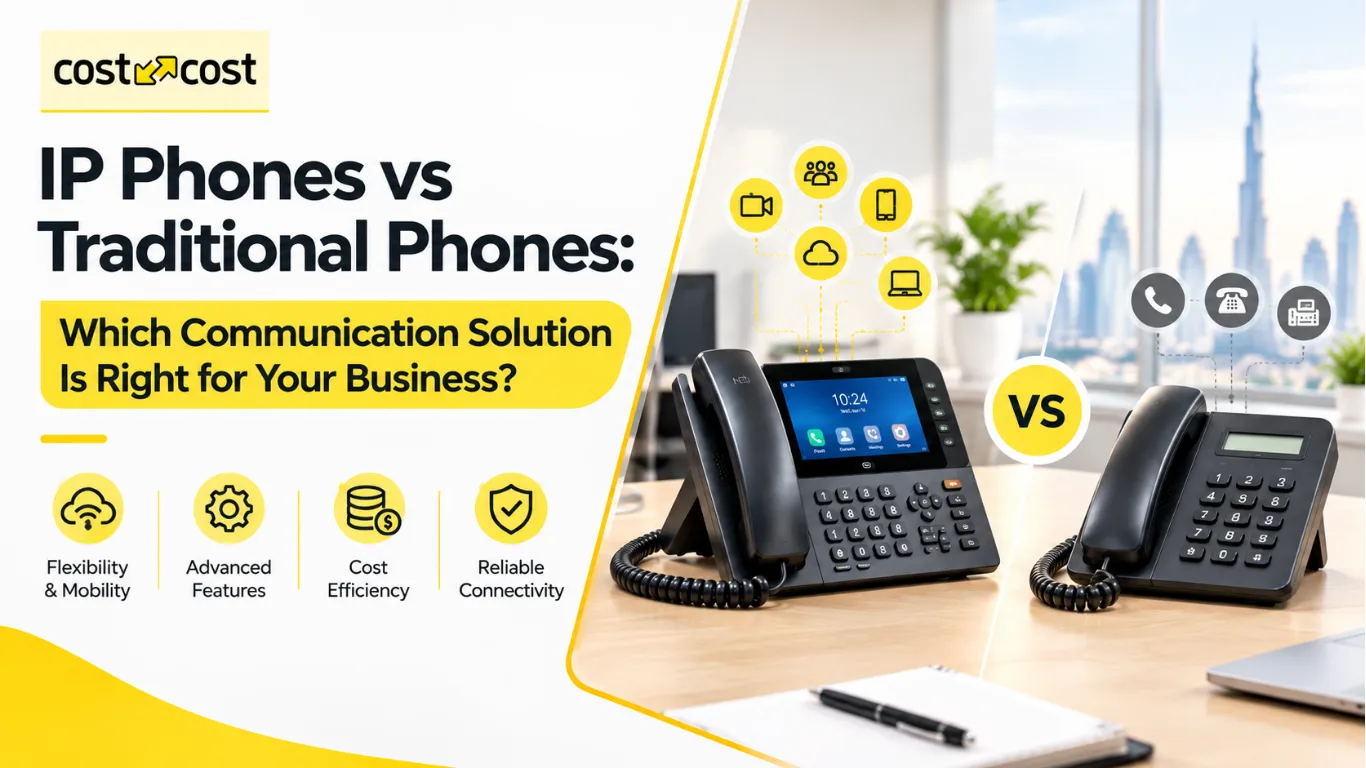
IP Phones vs Traditional Phones: Which Communication Solution Is Right for Your Business?
Sep
Business communication has changed significantly. Companies now need more than a phone that can simply make and receive calls. Features such as call transfer, extensions, voicemail, call routing, conferencing, remote access, and integration with other business tools can directly affect how efficiently teams communicate.
That is why many businesses are comparing IP phones vs traditional phones before upgrading their office communication systems. Traditional phone systems can still work well for certain businesses, while IP phones offer greater flexibility for companies using modern network infrastructure.
So, which one should your business choose? The answer depends on your business size, budget, network, calling requirements, number of users, and future growth plans.
What Is an IP Phone?
An IP phone is a business telephone that sends voice communication through an IP network instead of relying on a traditional telephone line. It converts voice into digital data and sends it through a network using technologies such as VoIP and SIP. IP phones can support features including extensions, call transfer, forwarding, voicemail, conferencing, and multiple lines.
Unlike a traditional telephone, an IP phone generally connects to the business network through Ethernet or, depending on the model, Wi-Fi. This allows the phone system to work alongside the company’s existing network infrastructure.
A typical business IP phone setup can include:
- IP phones
- IP PBX or cloud PBX
- Network switches
- Router
- Firewall
- Internet connection
- SIP service
For example, an employee can have a dedicated extension while calls can be transferred between departments without requiring a separate physical telephone line for every function.
What Is a Traditional Phone System?
A traditional business phone system uses conventional telephone infrastructure to carry voice calls rather than sending them through the company’s IP network. Depending on the setup, businesses may use physical telephone lines and a traditional PBX to manage extensions and internal calls. These systems are familiar and can be suitable where communication requirements are relatively simple.
Traditional phone systems have been used by businesses for many years because they are straightforward for basic calling.
A traditional setup may include:
- Physical telephone handsets
- Telephone lines
- PBX hardware
- Internal extensions
- Telephone cabling
For a small office that only needs a few phones and basic calling, this type of setup may still meet everyday requirements.
The bigger question is what happens when the business starts adding employees, branches, remote workers, or more advanced communication requirements.
IP Phones vs Traditional Phones: What Is the Main Difference?

The biggest difference is how calls are transmitted. Traditional phones generally use dedicated telephone infrastructure, while IP phones send voice communication over an IP network. This difference affects installation, scalability, features, remote access, and how the phone system connects with other business technologies.
Here is a simple comparison:
|
Feature |
IP Phones |
Traditional Phones |
|
Call transmission |
IP network/VoIP |
Traditional telephone infrastructure |
|
Network dependency |
Yes |
Generally no business internet dependency |
|
Scalability |
Flexible |
More dependent on physical infrastructure |
|
Extensions |
Easy to configure |
Often requires additional setup |
|
Remote working |
Strong support |
More limited |
|
Advanced features |
Wide range |
Usually more basic |
|
Integration |
Can integrate with business systems |
More limited |
|
Network requirement |
Requires suitable network |
Separate telephone infrastructure |
|
Management |
Can often be managed remotely |
More hardware-focused |
|
Best suited for |
Modern and growing businesses |
Simple, fixed communication needs |
The right choice is not automatically the newest technology. Your existing infrastructure and communication needs should come first.
How Do IP Phones Work?
IP phones work by converting your voice into digital data and transmitting it across an IP network. The call may travel through the company’s local network, internet connection, SIP service, and PBX before reaching the other person. This setup allows businesses to manage calls using software and network-based infrastructure.
A simplified business setup can look like this:
IP Phone → Network Switch → Router/Firewall → SIP/VoIP Service → Recipient
An IP PBX can sit within this setup and manage business functions such as:
- Extensions
- Call forwarding
- Call transfer
- Auto-attendant
- Voicemail
- Call queues
- Call recording
- Conference calling
SIP is commonly used to establish and manage voice and other communications over IP networks. Many business IP phones support SIP, which can provide greater flexibility when selecting compatible communication equipment.
What Are the Benefits of IP Phones for Businesses?
IP phones can give businesses greater flexibility by combining voice communication with existing network infrastructure. They can support extensions, call forwarding, conferencing, remote access, and other features without depending on the same type of physical telephone infrastructure used by traditional systems.
1. Easier Scalability
Adding employees to an IP-based phone system can be relatively straightforward when the PBX and network have sufficient capacity.
For example, a company with 20 employees may need 20 extensions today but 50 in the future. With a properly designed IP phone system, adding users can be handled through the PBX and network configuration rather than redesigning the entire telephone infrastructure.
This can be particularly useful for growing businesses.
2. Advanced Call Management
Modern IP phone systems can provide features that go beyond basic calling.
Depending on the system, businesses can use:
- Call transfer
- Call forwarding
- Auto-attendant
- Call queues
- Voicemail
- Call recording
- Multiple extensions
- Conference calling
- Programmable keys
These features can help reception, sales, customer service, and support teams handle calls more systematically.
3. Support for Remote and Hybrid Teams
Communication can be easier and more flexible via the internet (IP) if employees don’t need to use office phones or be situated at a certain desk. Often, employees can use various devices, from desktops to phones to tablets, to access work communication.
This is especially helpful for companies with workforces spread across different locations, like employees who work out of various offices or employees who work out of multiple different locations and travel a lot.
4. Better Integration Possibilities
IP communication systems can work alongside other digital business tools. Depending on the platform, businesses may integrate calling with CRM platforms, collaboration tools, contact management systems, or other applications.
This can help reduce the need to switch constantly between different systems when managing customer communication.
What Are the Benefits of Traditional Phones?
Traditional phones remain useful when a business has simple communication requirements and already has suitable telephone infrastructure. They can provide straightforward voice communication without making the business phone system dependent on the office’s data network or internet connection in the same way an IP phone system is.
For some businesses, simplicity is important.
Traditional phones may make sense when:
- The company has very few users
- Calling requirements are basic
- Existing telephone infrastructure is already available
- Advanced features are not required
- Remote communication is not a major requirement
- The business does not want to redesign its current setup
Another consideration is internet dependency. IP phone calls rely on the network, so poor connectivity or incorrect network configuration can affect voice communication. Traditional telephone infrastructure does not depend on the business LAN in the same way.
That does not mean traditional systems are automatically more reliable. It simply means reliability depends on different infrastructure.
IP Phones vs Traditional Phones: Which Is More Cost-Effective?
The total cost depends on the business setup rather than simply comparing the price of one IP phone with one traditional handset. Businesses should consider equipment, installation, infrastructure, maintenance, telephone services, number of users, call volume, and future expansion when comparing the two systems.
An IP phone system may require investment in:
- IP phones
- Network switches
- PoE
- PBX or cloud PBX
- SIP/VoIP service
- Network improvements
- Configuration and installation
A traditional system may require:
- Telephone handsets
- Telephone lines
- PBX equipment
- Telephone cabling
- Maintenance
- Additional physical infrastructure as users increase
For a growing business, the cost question is therefore not just “Which phone is cheaper?”
A better question is:
“Which communication system gives us the right features and infrastructure for the next few years?”
This approach can help avoid choosing a system that becomes restrictive as the business grows.
How Does Call Quality Compare?
Call quality depends heavily on the technology and infrastructure supporting the phone system. IP phones can deliver clear business calls when the network, bandwidth, configuration, and voice services are properly managed. Traditional phones use separate telephone infrastructure, so their call quality is influenced by that infrastructure instead.
For IP phones, businesses should pay attention to:
- Internet quality
- Network capacity
- Ethernet cabling
- Switch performance
- Firewall configuration
- Traffic management
- Wi-Fi coverage for wireless devices
A poor network can create problems such as delay, jitter, or dropped calls.
This is why installing expensive IP phones without checking the network first is not a good approach. CostToCost’s business phone system guide also highlights the importance of checking cabling, switches, routers, firewalls, internet connectivity, PoE, and overall network capacity before deploying IP phones.
Are IP Phones Better for Growing Businesses?
IP phones can be particularly useful for growing businesses because users, extensions, locations, and communication features can be expanded without necessarily rebuilding the entire phone infrastructure. However, scalability still depends on the capacity of the chosen PBX, network, SIP service, and other components.
Imagine a company starting with 15 employees.
Today, it may need:
- 15 extensions
- Basic call transfer
- Voicemail
- Reception phone
A few years later, it may need:
- 50+ employees
- Multiple departments
- Call queues
- Remote employees
- Call recording
- Multiple branches
- Conference communication
- CRM integration
An appropriately designed IP phone system can accommodate these changing requirements more flexibly than a fixed traditional setup.
What Role Does Network Infrastructure Play in IP Phones?

Network infrastructure is one of the most important considerations when installing IP phones because voice traffic travels through the network. Poor cabling, overloaded switches, weak connectivity, or unsuitable configuration can affect call quality even when the phones themselves are reliable.
Before choosing IP phones, check:
Ethernet Cabling:
Make sure the office cabling can support the required network speeds and connectivity.
Network Switches:
Businesses may need switches with suitable capacity and PoE support for certain IP phone installations.
Internet Connection:
The available bandwidth should be appropriate for voice and other business applications.
Firewall and Router:
Network security and traffic configuration should be considered during deployment.
Wi-Fi:
Wireless IP phones require appropriate coverage and network performance.
This matters even more when employees are using cloud applications, video conferencing, file-sharing platforms, and voice communication simultaneously.
Which Businesses Can Benefit From IP Phones?
IP phones can suit businesses that need flexible extensions, multiple departments, remote communication, advanced call management, or integration with modern business systems. They can be particularly useful for offices, customer service teams, sales departments, call centres, growing companies, and businesses operating across multiple locations.
For example:
Small Offices:
Can use basic IP phones with extensions, voicemail, and call transfer.
Sales Teams:
Can benefit from multiple lines, call forwarding, and other call-management features.
Customer Support Teams:
May need call queues, recording, and organized call routing.
Large Offices:
Can use centralized PBX systems to manage many users and departments.
Multi-Branch Businesses:
Can benefit from centralized communication and flexible extensions.
CostToCost currently offers IP phone options from brands including Yealink, Grandstream, Dinstar, Snom, Cisco, and Avaya, giving businesses different choices based on their communication requirements.
When Should a Business Stay With Traditional Phones?
A business may consider keeping its traditional phone system when its communication requirements are simple, the existing infrastructure works reliably, and there is little need for advanced features or remote access. Switching technology simply because it is newer may not make financial or operational sense for every company.
Traditional phones may remain practical when:
- The business has very few users
- Existing telephone infrastructure is reliable
- Employees work mainly from fixed desks
- Basic calling is sufficient
- There is limited demand for integrations
- The business has no immediate expansion plans
However, if the company is already planning an office expansion, adding departments, supporting remote workers, or upgrading its IT infrastructure, it may be worth evaluating IP phone systems at the same time.
IP Phones vs Traditional Phones: Which One Should You Choose?
For businesses that need scalability, advanced call management, remote access, and integration with modern IT systems, IP phones can provide a flexible communication foundation. Traditional phones can still suit businesses with simple, fixed calling requirements and suitable existing infrastructure. The decision should be based on business needs rather than technology preference alone.
Before making a decision, consider these questions:
- How many employees need phones?
- How many extensions are required?
- Do employees work remotely?
- Will the business add new users?
- Are multiple branches involved?
- Does the company need call queues or recording?
- Is CRM integration important?
- Is the current network ready for IP phones?
- What is the expected total cost?
- How will the communication system need to work three to five years from now?
Answering these questions will give you a much clearer idea of which solution fits your business.
What Should You Check Before Buying IP Phones?
Before buying IP phones, businesses should look beyond the handset itself and evaluate compatibility, network readiness, PBX requirements, required features, user count, and future expansion. Choosing the right phone model is important, but the overall communication infrastructure has a much bigger impact on the final experience.
Check the following:
Number of Users
Determine how many employees need individual extensions and how many phones are required.
Required Features
Do you need basic calling, or features such as call transfer, conferencing, multiple lines, voicemail, or programmable keys?
PBX Compatibility
Make sure the selected phones are compatible with your IP PBX or cloud communication platform.
PoE Requirements
If you plan to power phones through Ethernet, check whether your network switches support PoE.
Network Capacity
Review cabling, switches, internet bandwidth, routing, and firewall configuration.
Future Expansion
Avoid choosing a system that only works for today’s employee count.
Brand and Model
CostToCost lists business IP phone options from several established brands, including Yealink, Grandstream, Dinstar, Snom, Cisco, and Avaya.
Final Thoughts
Both VoIP and traditional phones allow businesses to facilitate communication. However, different infrastructure and business needs result in different phone systems. Tradition phones work well when communication is fixed and don’t require a lot of flexibility. IP phone systems provide the necessary flexibility for business communication. Whether it’s integrating different IT services or enabling communication for remote employees, IP phone systems are better equipped to facilitate it all.
It’s important to analyze your business and assess your needs and infrastructure when deciding on a phone system. Are your calling needs going to change in the future? What is your plan for business growth? How good is your network? How many employees do you have? These questions can help when making a business phone decision.
When upgrading your office communication system, look at your business communication needs first. Traditional businesses look at their business communication needs, evaluate their office needs and then choose a phone system to facilitate communication.
CostToCost telecom provides IP phones and other telecom equipment for the UAE.
Frequently Asked Questions
IP phones can be more flexible for businesses that need scalable extensions, advanced call features, remote access, and integration with modern communication systems. Traditional phones can still be suitable for businesses with simple calling requirements and reliable existing telephone infrastructure.
An IP phone sends voice communication through an IP network, while a traditional phone generally uses conventional telephone infrastructure. IP phones can support features such as extensions, call forwarding, conferencing, and other network-based communication functions.
IP phones require an IP network, but whether they require the public internet depends on the specific phone system. A business can use IP phones across its internal network, while internet connectivity is commonly needed when calls use cloud services, SIP providers, or external VoIP services.
Yes. Small businesses can use IP phones for basic extensions, call transfer, voicemail, and other business communication features. The system can also provide room for expansion if the business expects to add employees or communication requirements later.
Yes. IP phones can work with compatible IP PBX or cloud PBX systems. The PBX manages functions such as extensions, call routing, voicemail, call forwarding, and other communication features.
Not every IP phone requires PoE, but many business IP phones support Power over Ethernet. PoE allows a compatible network switch to provide power and network connectivity through the same Ethernet cable, which can simplify office installations.
Consider your number of users, existing network infrastructure, internet connection, PBX requirements, required features, budget, remote-work needs, and future growth. A network assessment before deployment can also help identify potential connectivity or configuration issues.