



























































Uncategorized
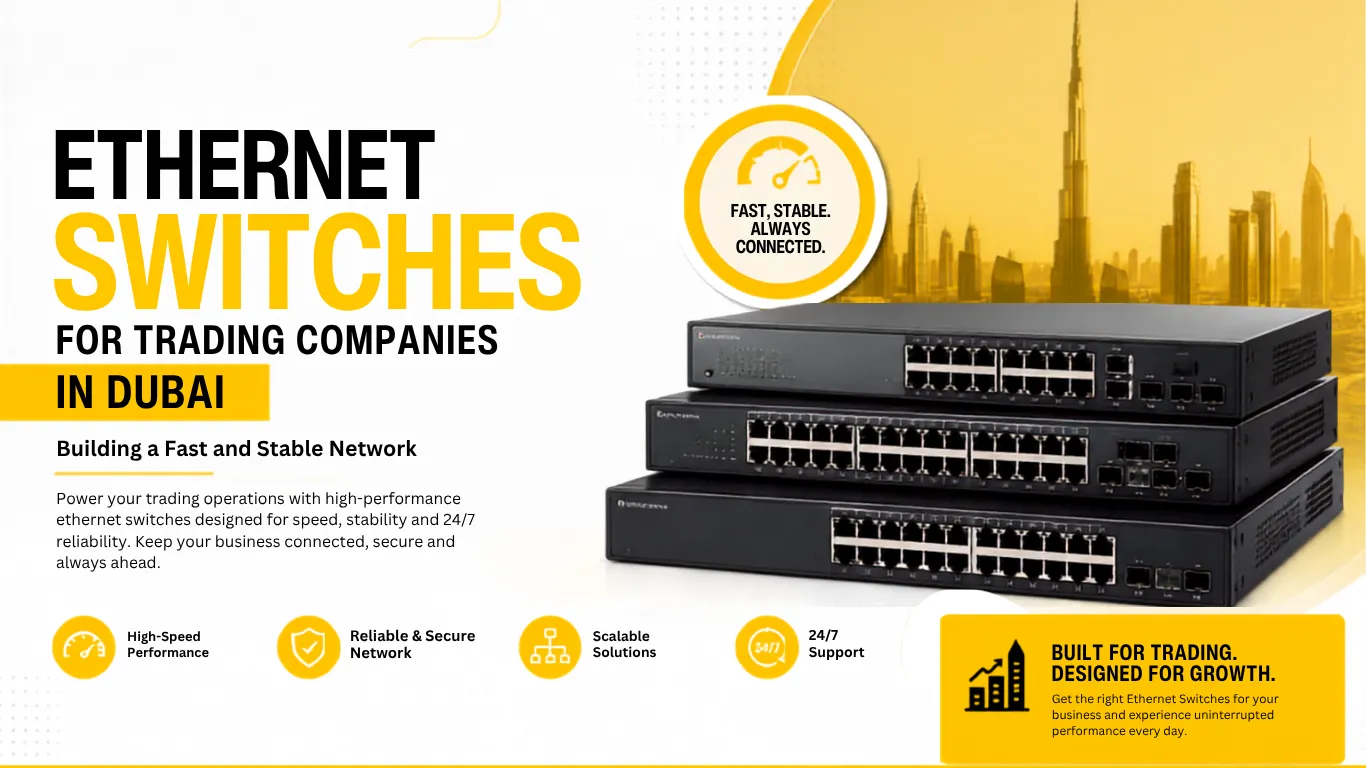
Ethernet Switches for Trading Companies in Dubai: Building a Fast and Stable Network
Aug
For trading companies, an efficient network is not an IT requirement. An unreliable network can slow daily business operations. Trading company employees use numerous business applications, systems, and interfaces on a daily basis to perform and manage various business functions. Slow and unstable networks impact daily productivity, even if the task intended to be performed is simple.
A network infrastructure designed for trading companies in Dubai must support and provide performance, reliability, security, and scale. Designing a network properly ensures the company’s employees, business functions, and applications communicate with each other, with efficiency, and without delays.
Network infrastructures utilize an Ethernet switch to connect the devices a company uses to communicate both internally and externally. Selecting the right switch is not an exercise in having the highest port count or connection speed. The right switch is a function of the company’s applications, users, and the overall network, security, and business function architecture.
Why Trading Companies Need a Reliable Network

Trading businesses need to manage a high volume of information daily. This includes employee communication with suppliers, customer order processing, inventory management, invoice creation, access to financial systems, and document transfer across departments.
If there’s a network outage, many of these tasks will be negatively impacted. Employees may be blocked from using critical applications, there may be an inventory update backlog for warehouse employees, and customer and/or vendor communications may be impacted. For businesses operating with short timelines, events such as these may quickly become operational nightmares.
Businesses need consistent networks in order for employees to work uninterrupted. When printers, computers, and other devices stay connected without interruption, employees are not distracted by connectivity issues.
Businesses with a network that spans multiple offices and warehouses may have an even greater challenge. The network must support a range of devices, users, and wireless inventory, communication, and surveillance systems.
Due to the nature of networks, Network Infrastructure for Trading Companies in Dubai must be future proof. This means designing networks with the expectation of future needs and developments.
What Role Do Ethernet Switches Play?
An Ethernet switch is a device that directs data in a local network to its appropriate recipient. An Ethernet switch is used to eliminate the need to transmit data to each connected device. An Ethernet switch has the ability to leave connected devices out of a data transmission.
Because Ethernet switches direct data to the appropriate device, desktop computers, servers, printers, IP phones, and network access points can communicate. They also allow the establishment of a structured wired local network environment.
Ethernet switches can also contribute to the structuring of a network’s topology. Switches can aid in the creation of a formal, structured network designed for ease of control and troubleshooting by incorporating access switches, distribution layers, and uplinks of increasing speed.
The type of switch that should be employed is that which best supports the needs of the business. A small business may require a simple Gigabit switch, while a large trading business may require managed switching, PoE, VLAN, high-speed uplinks, and a switch with centralized management.
Managed vs. Unmanaged Switches for Trading Companies
One of the first important decisions is between an unmanaged and managed switch for the business.
Most businesses consider unmanaged or managed switches for connecting their networks; however, these types of switches offer different levels of control. Sizing of the environment and networking complexity should be considered when choosing between unmanaged or managed switches.
An unmanaged switch is sufficient for a small office with only a few devices connected such as a couple of PCs and printers. Consider a managed switch for a business with different departments, storage facilities, IP Phones, CCTV, and Guest networks.
Unmanaged Ethernet Switches
For smaller networks requiring little to no advance configuration or monitoring, unmanaged switches are great plug-and-play options.
Because they require very little configuration, they can be useful for small trading offices with a small number of employees and relatively simple networking.
Businesses should be cautious when deciding to go for a solution that is unmanaged. If the network is likely to grow in the future, the inability to configure VLANs, monitor, and manage networking at an advanced level can lead to problems down the road.
Managed Ethernet Switches
Switches that are managed give businesses the flexibility needed for complex networking. Some feature traffic monitoring, VLAN management, port management and security, and prioritization of certain traffic.
Managed switching provides a stronger solution for businesses that use trading throughout multiple departments, lots of devices, and lots of warehouses and corporate IP Phones and CCTV. This solution is ideal for businesses with critical applications.
An additional benefit is that managed switching makes the administrator’s job easier when it comes to troubleshooting a network because of the increased visibility. The more the business grows, the greater the benefit over an unmanaged solution.
How VLANs Can Improve a Trading Company Network

A growing business should be cautious about connecting all of its devices to one flat network.
Trading companies often have separate needs for employee computers, finance systems, servers, IP phones, CCTV, warehouse equipment, guest Wi-Fi, and management devices.
In this case, VLANs (Virtual Local Area Networks) help IT teams logically separate different types of traffic.
Network organization is improved, and so is network security policy.
Positioning users on guest Wi-Fi in the same network as users of business applications would be a security exposure. Also, a CCTV device may need to communicate with the recording systems, but does not need to have any access to the business resources.
So, when businesses in Dubai have multiple operating units or multiple departments, VLANs can be a significant addition to a trading company’s network infrastructure.
Choosing the Right Network Speed
Network switches should be chosen based on the needs of the business, rather than the speed of the fastest switch.
In many business environments, Gigabit Ethernet is more than fast enough for PCs, printers, access points, and the software and devices used by a typical business. That said, connections to devices that have high traffic should be even faster.
10GbE connections can be used for NAS storage, servers, virtualization and backup systems, and large files that are transferred across the network.
The most important thing to remember is to look at the overall network architecture. Just purchasing a high-speed switch won’t make things faster for the entire network if connected devices and other parts of the network are not fast enough.
PoE Switches for Trading Offices and Warehouses
Devices equipped with Power over Ethernet (PoE) technology can receive both network connectivity and power using a single Ethernet cable.
This is especially useful for IP phones, wireless access points, and CCTV cameras, which can all receive both power and connectivity through a single cable — reducing cable clutter and simplifying deployment across offices and warehouses. When planning PoE, businesses should check the switch’s total power budget to ensure it can support all connected devices, including future additions.
Ethernet Switches and Network Security
A business network relies on more than just performance. Reliability is contingent on security.
Trading companies tend to have their customer information, supplier records, financial data, inventory data, and trade secrets or other confidential information all mixed together in their several company systems.
A network like this should be built on integrated security layers — firewalls, endpoint protection, access control, secure Wi-Fi, and appropriate monitoring.
Switches, on their own, are not firewalls, but managed switching can be a useful component at one level of a security architecture.
Monitoring Network Activity
Network monitoring allows IT teams to detect unusual traffic patterns, overloaded links, and disconnected devices before they turn into larger connectivity problems.
As a company grows, visibility over a network becomes increasingly important because it can save a lot of time when troubleshooting a large network without monitoring.
Certain models of managed switches can capture a lot of information about ports, devices, traffic, and a network’s performance.
Network Redundancy for Trading Businesses
For businesses that depend heavily on connectivity, downtime can be the most costly issue.
A trading company could suffer a loss of communication with critical elements of their operation due to employee inability to access their ERP applications, files, printers, and other assets.
Network redundancy mitigates this risk. The degree of redundancy is dictated by the size of the organization, the allocated budget, the company’s tolerance for downtime, and how long it can afford to be without a critical service.
Backup equipment, multiple network links, link aggregation, the Spanning Tree Protocol, dual internet connections, backup power, redundant firewalls, and multiple network paths are examples of redundancy available to a company.
Redundant Uplinks
Multiple network links can provide additional resilience between important network components. Depending on the architecture, technologies such as link aggregation can also increase available bandwidth.
This can be particularly useful when access switches connect to a core or distribution layer carrying traffic from many users.
Redundant connections can also help prevent a single cable or link failure from completely disconnecting a section of the network.
Backup Power
Network equipment depends on stable electrical power. UPS systems can provide temporary backup power during outages and help protect network equipment from sudden shutdowns.
For trading businesses where connectivity is critical, backup power should be considered as part of the broader infrastructure rather than as a separate concern.
A properly sized UPS can keep important networking equipment running during short power interruptions and provide time for controlled shutdowns when required.
Network Cabling Is Just as Important
Even the best Ethernet switches cannot compensate for poor cabling.
The physical network should be designed with appropriate cable categories, patch panels, connectors, racks, and cable management.
A professional structured cabling setup should include clearly labelled connections so IT teams can identify and troubleshoot network ports efficiently.
Poor-quality cables, incorrect terminations, excessive cable lengths, or unmanaged cabling can create intermittent connectivity problems that are difficult to diagnose.
Cat6 and Higher Cabling
Cat6 cabling is widely used for modern business networks and can support Gigabit Ethernet and, under suitable conditions, higher-speed connections.
The appropriate cable should be selected based on the required network speed, cable distance, installation environment, and future requirements.
For new office installations, businesses should consider future bandwidth requirements rather than selecting cabling based only on current devices.
Rack and Cable Management
Network racks should be organized so switches, patch panels, firewalls, UPS systems, and other equipment can be accessed safely.
Proper cable management improves airflow, reduces clutter, and makes future maintenance easier.
Clearly labelled patch panels and network ports also help technicians identify connections quickly when troubleshooting or expanding the network.
Building Scalable Network Infrastructure for Trading Companies in Dubai

One of the most common mistakes businesses make is designing a network only for today’s requirements.
A trading company with 30 employees today could have 60 or 100 employees in the future. Additional branches, warehouses, CCTV cameras, access points, IP phones, and cloud services can also increase network demand.
This is why Network Infrastructure for Trading Companies in Dubai should leave room for expansion.
Before purchasing equipment, businesses should consider current and expected:
- Number of employees
- Number of connected devices
- Expected employee growth
- Number of office locations
- Warehouse requirements
- Internet bandwidth
- Server and storage requirements
- Wi-Fi coverage
- Security requirements
- Future application requirements
Planning for these factors from the beginning can prevent businesses from replacing network hardware too frequently.
Leaving Room for Growth
Businesses should avoid selecting equipment with exactly the number of ports currently required.
Leaving spare ports provides flexibility when new employees join, additional devices are installed, or departments expand.
Similarly, uplink capacity should be planned according to potential future traffic rather than only today’s usage.
Supporting Multiple Locations
Trading companies with multiple branches may require centralized network management and secure connectivity between locations.
VPNs, SD-WAN, cloud connectivity, centralized monitoring, and appropriate security controls can help connect offices and warehouses while maintaining visibility over the wider infrastructure.
The network should also be designed so that adding a new location does not require completely redesigning the existing environment.
How to Select Ethernet Switches for Your Business
Instead of choosing a switch based only on price, businesses should evaluate several technical and operational factors.
The right device should fit into the existing network architecture and support the company’s current applications as well as expected future requirements.
Businesses should evaluate the following factors before making a decision.
Key factors to check before buying:
Port count — enough for all current wired devices, plus spare ports for future expansion
Port speed — Gigabit for standard users; faster uplinks for servers, storage, and high-traffic applications
PoE support — enough PoE ports and total power budget for phones, cameras, and access points
Managed features — VLANs, traffic monitoring, and centralized administration for larger or multi-department networks
Why Professional Network Planning Matters
A business network is more than a collection of switches and cables. The devices need to work together as one architecture.
A typical environment may include:
Internet → Firewall → Router/Gateway → Core/Distribution → Access Switches → End Devices
Servers, access points, IP phones, CCTV systems, and other equipment can then be connected according to the company’s requirements.
Professional planning helps determine where each component should be placed, how traffic should be segmented, which devices require PoE, and where higher-speed uplinks are necessary.
Network Assessment
Before upgrading equipment, businesses can assess existing hardware, traffic patterns, cabling, connected devices, and performance issues.
This helps identify bottlenecks and determine whether the business needs additional switches, faster uplinks, better cabling, network segmentation, or other improvements.
Future-Proof Infrastructure
Future-proofing does not mean purchasing the most expensive equipment available.
Instead, it means selecting infrastructure with enough capacity and flexibility to accommodate reasonable business growth.
A scalable design can reduce the need for frequent network replacements and make future upgrades easier.
Why Choose Cost To Cost for Business Networking Hardware?
Cost To Cost provides networking hardware for businesses, offices, and other organizations across the UAE. Its IT networking portfolio includes switches, routers, Wi-Fi access points, firewalls, network cables, NAS solutions, and related equipment.
For companies planning a new office network, warehouse setup, expansion, or hardware refresh, selecting compatible equipment from the beginning can help create a more reliable and scalable infrastructure.
The company offers networking products from established brands and provides businesses with different categories of networking equipment based on their technical and operational requirements.
Networking for Office and Warehouse Environments
Trading businesses often need connectivity across different office locations, storage facilities, supply-chain warehouses, meeting rooms, and operational spaces.
A well-designed network will span these spaces and support connected computers, phones, access control, surveillance, inventory, and other systems.
This results in improved communication across the business.
Final Thoughts
For trading companies, latency in the network negatively impacts internal employee communication, application availability, order processing, inventory management, and customer service.
While Ethernet switches enable a company to construct the backbone of a high-performance wired network, every component in the network architecture should be designed in order for switches to perform optimally.
A Network Infrastructure for Trading Companies in Dubai should include switching, structured cabling, network segmentation, security, high availability and redundant Wi-Fi, and long-term growth potential.
Designing the trading company infrastructure in line with the specific needs of the business will lead to a high performing, stable, and easy to manage network.
Whether expanding a trading office, adding a warehouse, opening a new branch, or upgrading an existing network, structuring it around specific business needs will improve performance.
frequently asked questions
Ethernet switches connect computers, servers, printers, access points, IP phones, CCTV systems, and other wired devices, allowing them to communicate across the business network. A suitable switch can also provide the connectivity and capacity needed for a growing organization.
Managed switches can be beneficial for businesses that need VLANs, traffic monitoring, port management, security controls, and greater network visibility. They are especially useful when the network includes multiple departments, branches, warehouses, or different categories of connected devices.
PoE switches can be useful when a business uses compatible IP phones, wireless access points, CCTV cameras, or other PoE-powered devices. They can simplify installation by carrying power and network connectivity through the same Ethernet cable.
The required port count depends on the number of wired devices. Businesses should also leave spare ports for future employees and equipment. Planning additional capacity from the beginning can make future expansion easier.
Gigabit connectivity can be sufficient for many office users, but servers, storage systems, virtualization, and high-volume data transfers may benefit from higher-speed connections. The correct speed should be determined according to actual network traffic and application requirements.
Network segmentation, secure Wi-Fi, firewall protection, access controls, updated equipment, monitoring, and appropriate VLAN design can contribute to a stronger business network. Security should be implemented as a layered approach rather than relying on the switch alone.
Businesses can explore Ethernet switches, routers, access points, firewalls, network cables, and other networking products through Cost To Cost UAE’s IT networking range. The right equipment should be selected according to the company’s network design, performance requirements, and future expansion plans.